
Phillips County Parole Versus Probation
A person can be outside Phillips County Jail yet remain subject to a court or corrections order. The source of that order determines where to verify it. Kansas Department of Corrections Parole Services supervises people released from Kansas prisons on parole, conditional release, or postrelease supervision. Probation is imposed by a court, often instead of incarceration or after a jail term. Current local probation information is best checked against the court case and Northwest Kansas Community Corrections.
The distinction matters because KASPER is strong for KDOC supervision but has a known probation gap. Its disclaimer says probation events after April 21, 2021 cannot be fully displayed during system modernization. A blank or old community-corrections result is not proof that Phillips County probation ended.
Conditional release is another Kansas corrections status. It differs from a judge placing someone on probation, even though both can put a person in the community with rules. Postrelease supervision follows the prison part of many determinate sentences. Parole applies to eligible cases in which the Prisoner Review Board makes a suitability decision. These labels should be copied exactly from the matched record because each points to a different authority and end date.
| Status | Authority | Best verification |
|---|---|---|
| Parole | Kansas Prisoner Review Board and KDOC | KASPER status, parole office, then KDOC confirmation |
| Postrelease supervision | Statute, sentence, and KDOC | KASPER and KDOC Parole Services |
| Probation | Sentencing court | Court docket and Northwest Kansas Community Corrections |
| Final discharge | KDOC or the court, based on the case | Discharge certificate, docket entry, or agency confirmation |
- Parole
- Community release for an eligible indeterminate prison sentence after a Board suitability decision.
- Postrelease supervision
- A supervision term that follows the prison portion of many Kansas determinate sentences.
- Probation
- A court-ordered community sentence with stated rules and oversight.
- Discharge
- The formal end of the sentence or supervision reflected by the responsible authority.
Verify Phillips County Post-Release Supervision
Begin with the legal source, not the live jail roster. That roster reports current Phillips County Jail custody. It does not show whether someone who left is now on probation, parole, or postrelease supervision. KASPER covers people in KDOC custody since 1980, people on post-incarceration supervision, and discharged sentences, subject to its stated limits. Compare more than a name before accepting a match.
- Open the KASPER search gateway, accept its terms, and search by first and last name.
- Narrow a common name with a KDOC or KBI number, date of birth, alias, physical details, conviction county, or supervision location.
- Open the result and compare the photo, case number, conviction county, and movement record. Then read supervision type and the listed parole office.
- For parole, conditional release, or postrelease supervision, confirm an unclear or time-sensitive result with KDOC Parole Services or the assigned office.
- For probation, search the Kansas District Court Public Access Portal for the order, later revocation entries, and discharge. Contact community corrections for present status.
- To prove that supervision ended, seek the formal discharge certificate or final court entry. Do not rely on roster absence or an old screen alone.
KASPER updates on working days and, according to the KDOC locating FAQ, daily except weekends. Same-day changes can lag. The matched agency remains the best source when the exact status matters.
The supervision-type controls can include Inmate, Parole, Discharged, Community Corr., Absconder, and other categories. Search filters help narrow candidates, but the open record supplies the facts. Conviction county “Phillips” can identify a local case. It should not be used as the sole test, since a person convicted in another county can later live or report in Phillips County. Likewise, a Phillips County conviction does not prove that the regional office still has the case.
For the broader jail-release and court-record path, use the Phillips County released inmate search after identifying which custody system held the person.
Note: A Phillips County jail release and a Kansas prison release are separate events that may lead to different supervision records.
Phillips County Probation Office Route
Northwest Kansas Community Corrections is the documented contact for community-corrections probation in the Phillips County area. Use it after matching the Phillips County court case, especially when KASPER does not show a newer probation event. The office can address its own supervision records; it does not replace KDOC Parole Services for a state parole case.
Northwest Kansas Community Corrections1011 Fort Street
Hays, KS 67601
785-625-9192
The KDOC parole and community-corrections contacts page identifies the proper regional route. Its published screen is useful for checking the Phillips and northwest Kansas assignment.
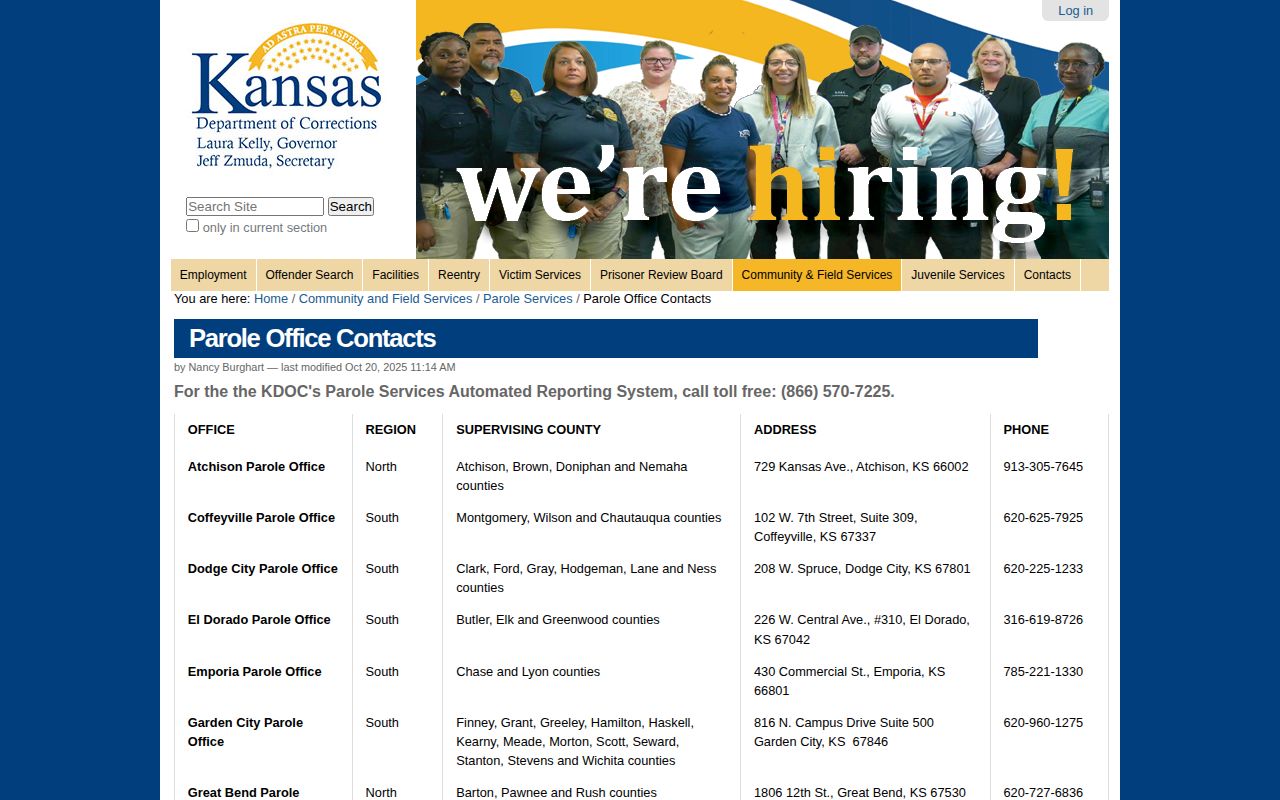
The contact listing helps separate probation support through community corrections from supervision tied to a KDOC prison release. For KDOC reporting, the Automated Reporting System is 866-570-7225, but an assigned officer or office is the case-specific authority.
Have the full name, case number, and known supervision type ready before calling. A precise question helps the office distinguish a Phillips County probation order from parole tied to a state sentence.
Phillips County Absconder Status Checks
KASPER can label a person as an absconder. In this setting, an absconder is someone alleged to have stopped complying with supervision or stopped reporting as required. The label does not mean the original release did not occur. It also does not show the full terms of a current warrant. Confirm live enforcement details with KDOC or the proper law-enforcement office before treating the public record as current.
The KASPER parole absconder filter permits a statewide search or a search by the last known supervision location.
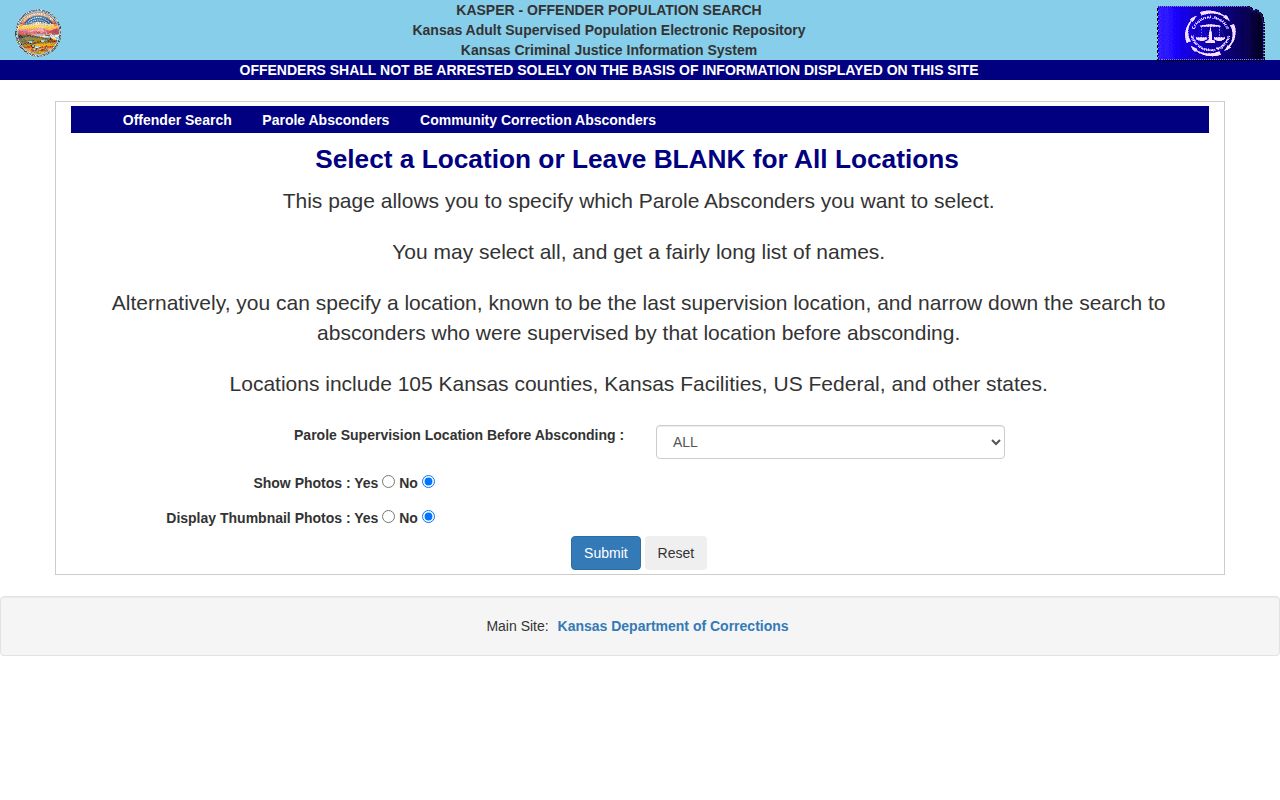
The filter is a lead to the KDOC record, not a warrant database. A later violation can return a person to custody, so KASPER may move from a community supervision label back to inmate status while the past release remains part of the record.
Phillips County Supervision Discharge
Physical release is not final discharge. A person may leave prison and serve a supervision term for months or years. Under K.S.A. 22-3722, satisfactory completion of parole or conditional release leads to final discharge, and completion of postrelease supervision requires a discharge certificate. A maximum-date release can satisfy the sentence without more Prisoner Review Board or KDOC supervision.
The certificate is the strongest source for the question, “Is supervision over?” A KASPER “Discharged” label can support the finding, but an agency record resolves uncertainty about which sentence ended. In a probation case, the Phillips County court docket should show discharge, revocation, or another closing event. Different cases can overlap, so the end of one term does not prove that every legal obligation ended.
Kansas open-record rules also shape what can be confirmed. K.S.A. 45-221 permits closure of some correctional records identifiable to a person, while carving out items such as custody or supervision level, parole office, sentence data, non-treatment conditions, and supervision violations. A request should name the exact record and date range. Protected medical, treatment, juvenile, sealed, or expunged material can still be withheld or redacted.
Note: Ask which sentence or case a discharge covers when the same person has more than one Phillips County matter.
Phillips County Parole Hearing Meaning
The Kansas Prisoner Review Board handles suitability for eligible indeterminate sentences. Most determinate guideline sentences for crimes committed after July 1, 1993 follow the statutory prison and postrelease structure instead of a discretionary parole grant. Under K.S.A. 22-3717, eligibility means the Board may consider release. It is not a promised release date.
Monthly public comment sessions are ordinarily held one month before the offender's hearing. The listed-offender page may show a hearing month and later eligibility month, but it is a pipeline, not a results database. The Board's terms include parole, continue, and pass. “Continue” delays a decision for more review. “Pass” denies parole for a set span.
No separate statewide public decisions database was found. Check later KASPER status and seek the written Board decision when available. A hearing listing alone does not show that a Phillips County person returned to the community.
The Board's process also separates release eligibility from supervision after release. A favorable outcome can authorize parole subject to processing and conditions. It does not establish that the person walked out on the hearing date. Facility movement, any other hold, and the final release event must still be checked. Once release occurs, Parole Services becomes the day-to-day source for the assigned office and current compliance status.
Phillips County Reentry Resource Limits
The sheriff's community-resources directory links legal and court resources, AA, NA, Al-Anon, crisis services, and Options. Those links can help a person or family find local support after release. The page is a navigation directory, however, not a formal Phillips County jail reentry program.
No county reentry office, halfway facility, work-release program, or local transport program was found in the reviewed official sources. That limit should remain clear. Supervision questions still go to KDOC, Northwest Kansas Community Corrections, or the sentencing court. Service referrals should be checked directly with the listed provider because a sheriff directory does not show enrollment, eligibility, or available space.